Why Context Graphs Matter Now for AI Agents?
In the past few months, AI has shifted from chatbots to agents, autonomous systems that don't just answer questions but make decisions, approve exceptions, route escalations, and execute workflows across enterprise systems. Foundation Capital recently called this shift AI's "trillion-dollar opportunity," arguing that enterprise value is migrating from traditional systems of record to systems that capture decision traces, the "why" behind every action.
But here's the problem: agents deployed without proper context infrastructure are failing at scale, with customers reporting "1,000+ AI instances with no way to govern them" and "all kinds of agentic tools that none talk to each other" as stated in Metadata Weekly. The issue isn't the AI models themselves, it's that agents lack the structured knowledge foundation they need to reason reliably.
The Missing Infrastructure: Relationship-Based Context
47% of enterprise AI users made at least one major business decision based on hallucinated content in 2024 MIT Sloan Management Review. Even when agents don't hallucinate outright, they struggle with multi-step reasoning that requires connecting distant facts across systems. An agent might know a customer filed a complaint and know about a recent product defect and know the refund policy, but fail to connect these relationships to understand why an exception should be granted.
As Prukalpa Sankar, co-founder of Atlan, frames it: "In 2025, in the dawn of the AI era, context is king" in her article. Context Graphs provide this missing infrastructure by organizing information as an interconnected network of entities and relationships, enabling AI agents to traverse meaningful connections, reason across multiple facts, and deliver explainable decisions.
This comprehensive guide explains what Context Graphs are, how they work, and why they're becoming essential infrastructure for enterprise AI.
What is a Context Graph? Definition, Use Cases & Implementation Guide
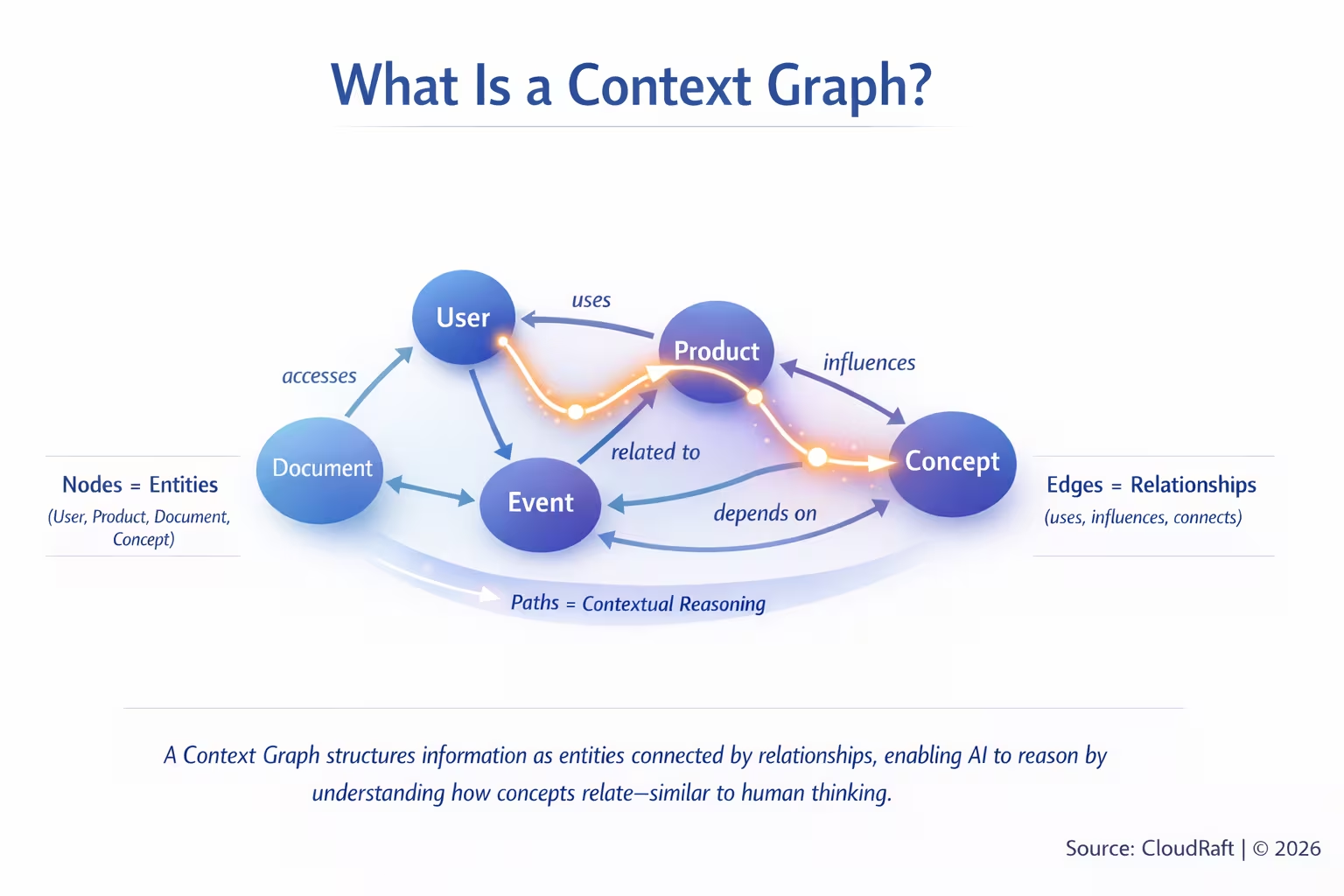
How Context Graphs Work
Context Graphs transform raw data into a semantic network of nodes (entities like people or projects), directed edges (relationships such as "worked_on" or "depends_on"), and properties (key-value details on both). This structure enables AI agents to perform graph traversals, starting from a query node and following relevant edges, for dynamic context assembly and multi-hop reasoning, unlike rigid keyword or vector searches.
Core Components:
- Nodes: Represent real-world entities (e.g. "ProjectX"). Each holds properties like name, type, or timestamp.
- Edges: Directed connections with types (e.g. → "worked_on" →) and properties (e.g. role: "lead", duration: "6 months"). Directions indicate flow, like cause-effect.
- Properties: Metadata attached to nodes/edges (e.g., confidence score on an edge), enabling filtered traversals.
Traversal Process:
- Query Entry: Input like "API security projects" matches starting nodes via properties or embeddings.
- Neighbor Expansion: Fetch adjacent nodes/edges, prioritizing by relevance (e.g., recency, strength).
- Multi-Hop Pathfinding: Traverse 2-4 hops (e.g. Project → worked_on → Engineer → similar_to → AuthSystem), using algorithms like BFS or HNSW-inspired graphs for efficiency.
- Context Assembly: Aggregate paths into a subgraph, feeding it to LLMs for grounded reasoning.
- Explainability: Log the path for auditing.
This mirrors vector DB indexing (e.g. HNSW in Pinecone) but emphasizes relational paths over pure similarity.
Example in Action:
Traditional Vector Search (e.g., Pinecone nearest-neighbor): "API security projects" → Returns docs with similar embeddings (e.g. 3 keyword matches).
Context Graph Traversal:
# sample cypher query
MATCH (p:Project)-[:RELATED_TO]->(t:Topic {name: 'API Security'})-[*1..3]-(related) RETURN *
sql- Start: Projects tagged "API Security".
- Hop 1: → worked_on_by → Engineers (properties: skills="OAuth").
- Hop 2: Engineers → also_worked_on → AuthSystems.
- Hop 3: AuthSystems → depends_on → OAuthProtocols (properties: version="2.0").
- Output: Subgraph with projects, team, deps, contributors—plus path visualization for explainability.
Key Characteristics of Context Graphs
-
Relationship-Centric Design: Context Graphs prioritize connections over isolated records. This makes it natural to understand how concepts relate, not just what they contain.
-
Multi-Hop Reasoning: The graph structure enables AI to connect distant concepts through intermediate relationships, reasoning across multiple steps just as humans do. Example: Connecting "customer complaint" → "product defect" → "supplier issue" → "quality control process" in three hops.
-
Dynamic Context Assembly: Rather than retrieving fixed search results, Context Graphs assemble context on the fly by traversing only the relationships relevant to your specific query.
-
Built-in Explainability: Every AI decision can be traced back through its relationship path. You can see exactly how the system reached a conclusion, critical for enterprise and regulated environments.
-
Temporal Intelligence: Context Graphs model sequences, dependencies, and cause-and-effect relationships over time, making them ideal for understanding evolving processes and events.
-
Enterprise Scalability: Modern graph databases handle millions of entities while maintaining fast traversal and query performance at scale.
Context Graph vs Knowledge Graph vs Vector Database
| Feature | Context Graph | Knowledge Graph | Vector Database |
|---|---|---|---|
| Primary Focus | Contextual relationships for AI reasoning | General knowledge representation | Semantic similarity matching |
| Reasoning Type | Multi-hop traversal | Structured queries | Nearest neighbor search |
| Best For | Dynamic AI context assembly | Structured domain knowledge | Semantic search, RAG |
| Explainability | High (shows relationship paths) | Medium | Low (similarity scores only) |
| Query Complexity | Complex multi-step reasoning | Medium complexity | Simple similarity queries |
Note: These technologies complement each other. Many advanced AI systems use Context Graphs for reasoning combined with vector databases for semantic search.
Real-World Context Graph Use Cases
Enterprise Knowledge Management: Connect projects, people, decisions, and outcomes across your organization. Instead of finding where files live, trace how work evolved, what decisions shaped results, and who has relevant expertise. This will reduce your knowledge discovery time.
Intelligent Customer Support: Go beyond keyword matching. Connect customer history, product configurations, known issues, and documented resolutions to provide contextually accurate answers. This will reduce your ticket resolution time.
Scientific Research & Discovery: Connect millions of research papers, creating networks of studies, methodologies, findings, and citations. Discover unexpected connections between seemingly unrelated fields. You can identify underexplored research areas by analyzing relationship patterns and citation gaps.
Compliance & Risk Management: Map relationships between regulations, internal policies, business processes, and controls. When requirements change, trace exactly where those changes affect systems and workflows. This will reduce your compliance audit preparation time.
Healthcare Diagnostics: Connect symptoms, medical history, medications, genetic factors, and research findings. Enable diagnostic systems to reason across these relationships and identify conditions that isolated analysis might miss. This will improve diagnostic accuracy by surfacing relevant but non-obvious connections.
Supply Chain Optimization: Model your entire supply network, suppliers, components, products, logistics partners, enabling sophisticated scenario analysis and rapid disruption response. For example, when supply issues arise, it will quickly identify alternative suppliers by traversing compatibility, certification, and performance relationships.
Legal Research & Analysis: Map relationships between cases, statutes, legal principles, and precedents. Trace how legal concepts evolved across jurisdictions and time periods. This would reduce legal research time.
Personalized Recommendations: Go beyond "customers who bought this also bought that." Understand topical relationships, creator connections, and contextual relevance to deliver truly personalized recommendations. This would increase engagement through unexpected but relevant discoveries.
Financial Risk Assessment: Model relationships between entities, transactions, accounts, and market factors. Detect complex fraud patterns spanning multiple accounts and understand how risks cascade through connected entities. This would detect more fraud patterns than traditional rule-based systems.
Software Development Intelligence: Map relationships between functions, modules, dependencies, documentation, and issues. Understand how code changes ripple through your system before making modifications. This would reduce breaking changes through comprehensive impact analysis.
Benefits of Context Graphs for AI Agents
-
Reduce AI Hallucinations: Ground AI outputs in explicit, verifiable relationships rather than probabilistic pattern matching alone.
-
Improve Reasoning Accuracy: When answers require connecting multiple facts across domains, Context Graphs significantly outperform retrieval-only approaches.
-
Enable Explainable AI: Expose the exact path the AI took through your knowledge graph, making decisions transparent and auditable.
-
Scale Without Schema Rigidity: Add new entity types and relationships without forcing disruptive schema migrations.
-
Surface Hidden Insights: Discover patterns and connections that are nearly impossible to detect in traditional table or document structures.
-
Maintain Context Across Interactions: Preserve relationship context throughout multi-turn conversations, enabling more sophisticated AI interactions.
How to Implement Context Graphs
Step 1: Select Your Graph Database
Choose based on scale, query patterns, and infrastructure:
Some Popular Options:
- Neo4j: Most mature, enterprise-ready, excellent query language
- Amazon Neptune: Managed AWS service, good for existing AWS infrastructure
- TigerGraph: Best for massive scale and complex analytics
- ArangoDB: Multi-model database with graph capabilities
- FalkorDB: Ultra-fast in-memory graph database built on Redis, best for low-latency real-time applications
Decision Factors: Query complexity, data volume, team expertise, budget
Need help choosing a graph database?
Schedule a free consultation with CloudRaft experts.

Step 2: Design Your Relationship Schema
The value of a Context Graph depends on modeling the right entities and relationships.
Best Practice: Collaborate closely with domain experts who understand:
- What entities matter in your domain
- Which relationships drive important decisions
- How information flows through your processes
Example Schema (Customer Support):
- Entities: Customer, Ticket, Product, Issue, Resolution, Agent
- Relationships: reported_by, relates_to, resolved_with, escalated_to, similar_to
Step 3: Build Entity Extraction
Identify entities in your source data:
For Unstructured Text:
- Use NLP pipelines
- Fine-tune LLMs for domain-specific entity recognition
- Implement human-in-the-loop validation for critical entities
For Structured Data:
- Map existing database fields directly to graph entities
- Normalize entity references across systems
Step 4: Develop Relationship Extraction
Beyond identifying entities, determine how they relate:
Approaches:
- Rule-based: Define explicit patterns (if X mentions Y in context Z, create relationship R)
- ML-based: Train models to identify relationship types from text
- LLM-based: Use large language models for sophisticated relationship inference
- Human validation: Review critical relationship paths
Step 5: Enable Real-Time Updates
Context Graphs are living systems requiring continuous updates:
- Implement event-driven architecture for data changes
- Design incremental update patterns (don't rebuild everything)
- Maintain data lineage for troubleshooting
- Build conflict resolution for concurrent updates
Step 6: Optimize Query Performance
Keep multi-hop queries responsive at scale:
- Index critical properties used in traversals
- Cache frequent query patterns
- Limit traversal depth for expensive queries
- Denormalize selectively for performance-critical paths
- Use query profiling to identify bottlenecks
Step 7: Integrate Graph Analytics
Enhance your Context Graph with advanced algorithms:
- PageRank: Identify influential nodes
- Community Detection: Find clusters of related entities
- Path Finding: Discover optimal routes through relationships
- Graph Embeddings: Enable similarity calculations
- Link Prediction: Suggest missing relationships
Implementation Challenges & Solutions
| Challenge | Why It Matters | Practical Solution |
|---|---|---|
| Graph Construction Complexity | Building comprehensive graphs requires sophisticated entity and relationship extraction from unstructured data | Start with a focused domain where you have high-quality structured data. Expand gradually as you build extraction capabilities. |
| Schema Design Expertise | Effective schemas demand deep domain understanding, poor design leads to unusable graphs | Run workshops with subject matter experts. Build iteratively: start simple, refine based on actual query patterns. |
| Performance at Scale | Graph traversals become expensive for complex multi-hop queries as data grows | Invest in proper indexing, implement query optimization, use caching strategically, and set traversal depth limits (2-4 hops). |
| Entity Resolution | Identifying that different mentions refer to the same entity is difficult but critical for accuracy | Implement fuzzy matching, leverage unique identifiers where available, use ML-based entity resolution tools, maintain a golden record system. |
| Quality Maintenance | As graphs grow to millions of relationships, maintaining accuracy becomes challenging | Implement automated validation rules, schedule periodic audits, track data lineage, enable user feedback loops for corrections. |
| Integration Complexity | Incorporating Context Graphs into existing systems requires architectural changes and API design | Build a graph API layer that existing systems can call. Start with read-only integration, add write capabilities once proven. |
| Skill Gap | Shortage of professionals experienced in graph technologies and query languages like Cypher | Train existing team members (graph databases are learnable, similar to SQL), hire contractors for initial setup, or partner with CloudRaft for implementation guidance. |
| Cost Management | Context Graphs add infrastructure costs for databases, extraction pipelines, and real-time analytics | Start with a high-value use case to demonstrate ROI. Scale infrastructure based on actual usage patterns. Monitor cost per query and optimize expensive operations. |
Context Graph Best Practices
Design Principles
-
Model relationships that drive decisions: Don't create relationships just because you can. Focus on connections that enable valuable reasoning.
-
Keep entity types focused: Avoid creating overly granular entity types. Each entity type should represent a meaningful concept in your domain.
-
Make relationships meaningful: Generic relationships like "related_to" provide little value. Use specific relationship types: "depends_on," "caused_by," "replaces."
-
Balance normalization and performance: Highly normalized graphs are elegant but can be slow. Denormalize strategically for frequently traversed paths.
-
Version your schema: Graph schemas evolve. Maintain version history and migration paths.
Query Optimization
-
Limit traversal depth: Set maximum hops to prevent runaway queries. Most valuable relationships are within 2-4 hops.
-
Filter early: Apply constraints as early as possible in your traversal to reduce the working set.
-
Use indexed properties: Index properties you filter on frequently. This dramatically improves query performance.
-
Cache common patterns: Identify frequently executed query patterns and cache results with appropriate TTLs.
Data Quality
-
Implement validation rules: Define constraints on entity properties and relationship validity to maintain quality automatically.
-
Track provenance: Know where each entity and relationship came from. This enables troubleshooting and quality assessment.
-
Enable feedback loops: Allow users to report incorrect relationships. Use this feedback to improve extraction pipelines.
-
Schedule audits: Periodically review graph quality, especially for critical relationship paths.
Context Graphs + LLMs: A Powerful Combination
Context Graphs and Large Language Models (LLMs) complement each other:
Graph-Augmented Generation (GAG): Retrieve relevant subgraphs from your Context Graph and provide them as structured context to LLMs. This reduces hallucinations and grounds responses in your actual knowledge.
LLM-Assisted Graph Construction: Use LLMs to extract entities and relationships from unstructured text, building your Context Graph more quickly than rule-based approaches alone.
Explainable LLM Reasoning: When LLMs generate responses based on graph context, you can trace exactly which relationships influenced the output.
Hybrid Retrieval: Combine vector search (for semantic similarity) with graph traversal (for relationship reasoning) to get the best of both approaches.
Measuring Context Graph Success
Track these metrics to assess your Context Graph implementation:
Query Performance
- Response time: Median and 95th percentile query latency
- Throughput: Queries per second at peak usage
- Cache hit rate: Percentage of queries served from cache
Data Quality
- Entity accuracy: Percentage of correctly identified entities
- Relationship precision: Percentage of relationships that are actually valid
- Coverage: Percentage of domain knowledge captured in the graph
Business Impact
- Time saved: Reduction in research/discovery time
- Accuracy improvement: Better decision quality from enhanced reasoning
- Cost reduction: Decreased manual effort for knowledge work
- User satisfaction: NPS or satisfaction scores for graph-powered features
AI Performance
- Hallucination rate: Reduction in factually incorrect AI outputs
- Reasoning accuracy: Percentage of multi-hop questions answered correctly
- Explainability: Percentage of AI decisions with traceable reasoning paths
The Future of Context Graphs
Context Graphs are evolving rapidly:
Emerging Trends
-
Graph + Vector Hybrid Systems: Combining semantic vector search with graph reasoning for more sophisticated AI systems.
-
Automated Schema Evolution: ML systems that automatically suggest new entity types and relationships based on usage patterns.
-
Real-Time Graph Analytics: Stream processing for graph updates and real-time pattern detection.
-
Multi-Modal Graphs: Incorporating images, audio, and video as first-class entities with rich relationships.
-
Federated Graphs: Connecting knowledge graphs across organizational boundaries while maintaining privacy and security.
Getting Started with Context Graphs
Ready to implement Context Graphs in your AI systems?
Start Small, Think Big
- Identify a high-value use case where relationship reasoning matters
- Map your initial schema with domain experts (10-20 entity types is plenty to start)
- Build a proof of concept with a subset of your data
- Measure impact against your baseline approach
- Iterate and expand based on what you learn
Common Starting Points
- Customer support: Connect tickets, customers, products, and resolutions
- Internal knowledge: Link documents, projects, people, and decisions
- Compliance: Map regulations, policies, processes, and controls
- Product development: Connect features, dependencies, bugs, and releases
Conclusion
Context Graphs represent a fundamental shift in how AI systems understand and reason about information. By capturing not just data, but the rich network of relationships that gives data meaning, they unlock AI capabilities that were previously unattainable:
- More accurate reasoning through multi-hop traversal
- Explainable decisions via traceable relationship paths
- Reduced hallucinations by grounding in verifiable connections
- Scalable knowledge management without rigid schema constraints
As AI becomes increasingly central to enterprise operations, Context Graphs will evolve from competitive advantage to foundational infrastructure. Organizations that build graph-based AI capabilities now will be well-positioned to lead in an AI-driven future.
The question isn't whether to adopt Context Graphs, it's when and where to start.
Expert Help with Context Graph Implementation
Building Context Graphs requires specialized expertise in graph databases, knowledge representation, and AI integration. CloudRaft provides complimentary AI consultations to help you:
- Assess feasibility for your specific use cases
- Design optimal schemas for your domain
- Architect scalable infrastructure that grows with your needs
- Integrate with existing AI systems seamlessly
- Train your team on graph technologies
Want to explore how Context Graphs can transform your AI capabilities?
Connect with a CloudRaft expert today for a free consultation
Frequently Asked Questions
What's the difference between a Context Graph and a Knowledge Graph?
Context Graphs are specialized knowledge graphs optimized for dynamic context assembly in AI systems. While knowledge graphs broadly represent domain knowledge, Context Graphs focus specifically on enabling AI reasoning through relationship traversal.
Can I use Context Graphs with vector databases?
Absolutely. Many advanced AI systems use both, vector databases for semantic similarity search and Context Graphs for relationship reasoning. This hybrid approach provides the best of both worlds.
How much data do I need to start?
You can start small. Even a few thousand entities with well-modeled relationships can demonstrate value. Focus on quality relationships over quantity.
What's the typical implementation timeline?
For a focused proof of concept: 4-8 weeks. For production-ready implementation: 3-6 months. Timeline depends on data complexity, schema design, and integration requirements.
Do I need specialized graph database skills?
While helpful, they're not mandatory. Graph query languages like Cypher (Neo4j) are learnable, similar to SQL. Consider training existing team members or partnering with experts for initial setup.
How do Context Graphs reduce AI hallucinations?
By grounding AI responses in explicit, verifiable relationships rather than relying solely on probabilistic pattern matching from training data. The AI can only traverse relationships that actually exist in your graph.
What's the ROI of implementing Context Graphs?
Varies by use case, but organizations typically see: reduction in knowledge discovery time, improvement in AI reasoning accuracy, and reduction in manual research effort. ROI is highest for knowledge-intensive workflows.
Can Context Graphs work with my existing databases?
Yes. Context Graphs complement existing databases. You can keep transactional data in relational databases and build Context Graphs for relationship reasoning, syncing data between systems.


