TL;DR
- AI-native engineering evolved through five stacked layers: Prompt (2023), Context (mid-2025), Harness (early 2026), Loop (June 2026), and Graph (late July 2026) — each new layer covers what the previous one could not.
- Each layer fixes a distinct failure: prompt quality, missing information and memory, inconsistent unsupervised runs, single-pass execution with no retry, and multi-agent handoff and coordination.
- Match the fix to the broken layer: tune prompts for output quality, add context for hallucinations, add a harness for uncaught breakage, add loops for tasks needing retries, and add graphs only when multiple agents must coordinate.
- The shift is from writing code to designing the systems that write, check, and coordinate code — engineers who can diagnose the broken layer stay relevant when the buzzword changes.
If you've spent any time on X these days or following AI news you certainly have heard of "Graph Engineering". It's all over the place every other AI influencer talking about it, writing about it, making a Youtube video about it.
But we have seen this pattern before. Many times.
- In 2023, it was Prompt Engineering
- In Mid 2025, it was Context Engineering
- In Early 2026, it was Harness Engineering
- In June 2026, it was Loop Engineering and now
- In Late July 2026, it's Graph Engineering
That's 5 concepts in 3 years. But the thing is none of these actually replaced the one before it, each term took over the moment task complexity broke the previous one. Software engineering has always evolved this way. Waterfall gave way to Agile because plans couldn't react to change fast enough. Agile wasn't enough on its own as deployment became a bottleneck so DevOps extended it, CI/CD is what actually made DevOps work, automated pipelines that test and ship code the same way every time, because manual checks couldn't keep up once systems got complex. None of these killed the one before it, they just stacked on top to cover what the last one couldn't. The Prompt to Graph ladder is doing the same thing, just squeezed into three years instead of three decades.
So Instead of picking a side in whatever fight is trending on X, let's actually walk the ladder and see what problem each layer solves.
Prompt Engineering
This is where it all started. The same model with a differently phrased input would produce a very different output.
If you simply ask "Summarize this article" you'll probably get a generic, unfocused low quality summary that doesn't tell you what you really want to know. Whereas a clear prompt like "As a senior editor, summarize this article in 3 paragraphs core claims, evidences and limitations, 150 words each" gets you something you can actually use.
For a while, this was the entire game. People built careers on knowing the right prompt technique like few-shot examples, chain-of-thought triggers, the right system prompt structure etc.
But the prompt engineering had a limitation, it assumes the model already knows everything it needs to answer but most of the time it doesn't. You can phrase a question perfectly and still get a bad answer, because the model doesn't have the information it needs at the moment.
And this gap is what Context Engineering was built to close.
Context Engineering
Context Engineering is about "what does the agent know, see and remember right now?" A prompt is an instruction, Context is everything else retrieved documents, memory of earlier steps, tool output, policies etc.
The term traces back to Shopify CEO, who argued in mid-2025 that "prompt engineering" undersold the real skill. What mattered wasn't the clever phrasing, but the art of providing all the context for the task to be plausibly solvable by the LLM. Karpathy backed the shift too, and that's when the term took off. Because by then, most failures weren't phrasing failures anymore, they were information failures. The model was being asked to do things it simply had no visibility of.
The practical playbook that came out of this era boils down to four moves: write the right instructions, select the relevant context, compress what's wasting tokens, and isolate what shouldn't be mixed together. Get this right, and the agent stops guessing and starts working with what it actually needs.
But here's the limitation, you can give a perfect context window to a model and it can still behave inconsistently, different output on different runs, no clear accountability for how it got there. Knowing the right things doesn't guarantee doing them the same way twice.
That gap of a reliable system around the model, not just a good input to it, is why Harness Engineering was introduced.
Harness Engineering
Harness Engineering solved for a runtime around the model, the actual machinery that turns a raw model into something you can trust to run unsupervised: the repo-level instructions, the tool permissions, the checks that can catch bad output before it ships, the configuration that decides how the agent is allowed to behave.
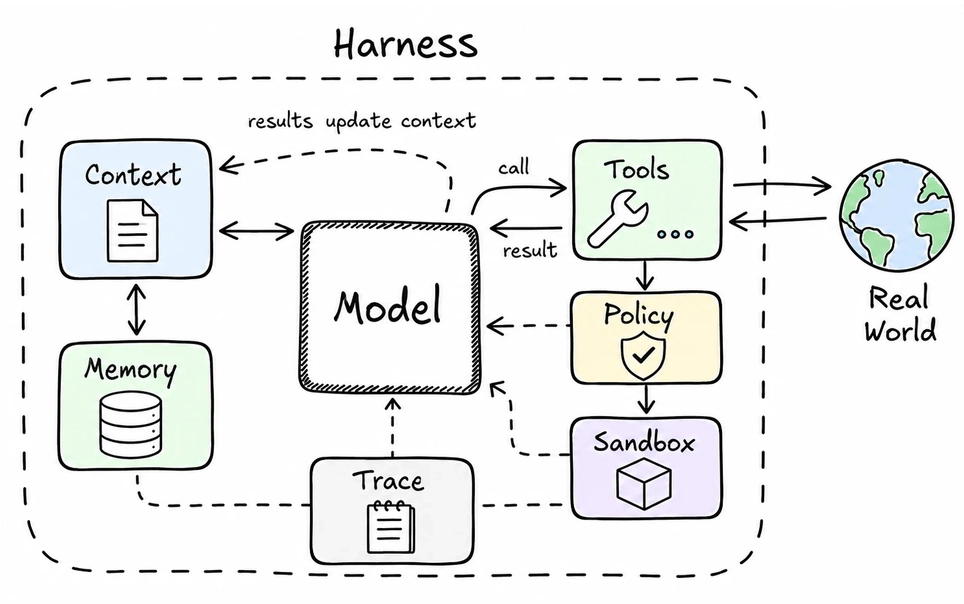
Source: https://www.piyushvyas.com/blog/harness-engineering
It started gaining traction in early 2026, as teams building coding agents and production AI systems realized the model itself had mostly stopped being the differentiator, everyone had access to roughly the same frontier models. What separated a reliable agent from a flaky one was the harness around it.
To understand it properly let's take an example of a content generation system consisting of planner, generator and evaluator agent. Harness defines the roles, decides how work hands off between them, and applies verification gates so a bad output doesn't just quietly ship. It's less about intelligence and more about accountability, making sure there's a system that catches the model when it's wrong, instead of trusting it to be right every time. This is the same idea behind things like Claude Code's tool permissions or a CI/CD gate that blocks a merge until tests pass, the intelligence doesn't change, but the rules around it does.
Get the harness right, and the same model suddenly behaves consistently. Same task, same guardrails, same output quality, run after run. But here's the problem: even a well built harness handles only one pass. It doesn't tell the agent to keep going, check its own work, and try again if it's wrong.
That missing mechanism to iterate without a human re-prompting after every step is why Loop Engineering came next.
Loop Engineering
Loop Engineering gives agents a mechanism to run autonomously, check its own result, and try again without a human sitting there re-prompting it every time.
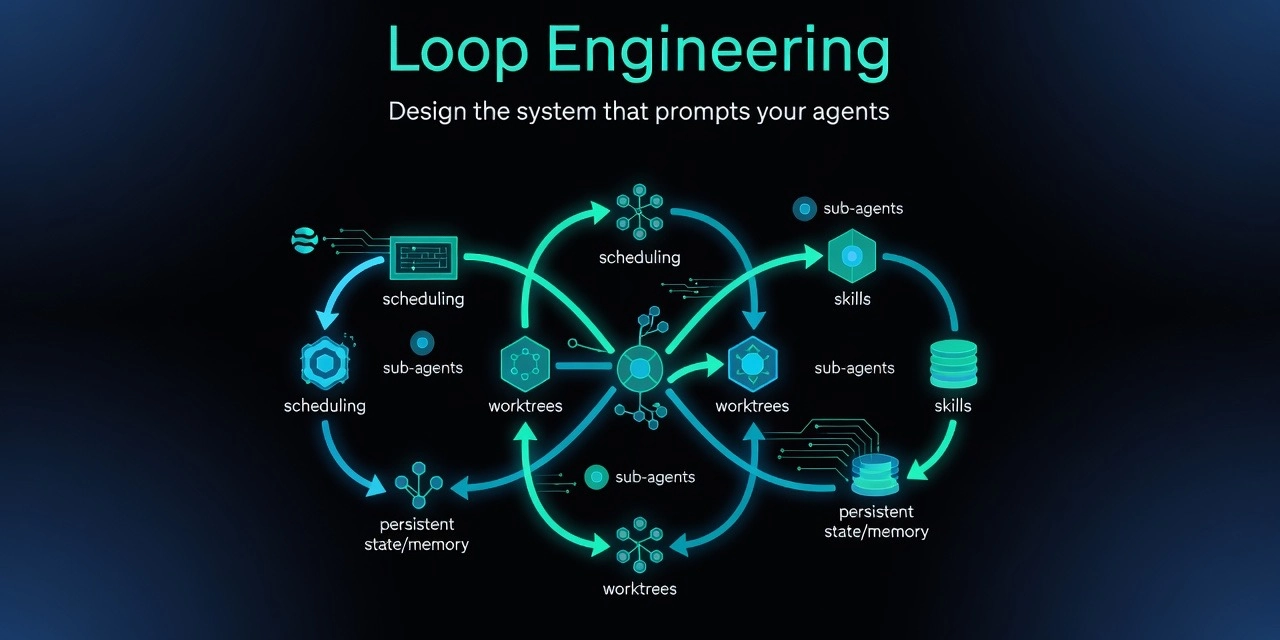
Source: https://github.com/cobusgreyling
It started gaining traction around June 2026 after Boris Cherny, head of Claude Code speaking at Fortune Brainstorm Tech 2026 said "I don't prompt Claude anymore. I have loops running that prompt Claude and figuring out what to do. My job is to write loops".
The core mechanics are simple: the agent acts towards a goal, an external signal checks whether the result is actually good, a failed attempt gets fed back in for another try, and a hard stop keeps things from running forever if it never converges.
Let's take an example of a coding agent, assigned to fix a failing test. It writes a fix, runs the test suite, sees it still fails, reads the new error, and tries again. No human is needed in between the attempts.
The loop is what kept the agent working until the job was actually done. Get the loop right, and a single agent can carry a task from start to finish on its own, retrying against a real signal instead of guessing when to stop.
But here's the limitation: a loop assumes one job and one agent doing it. Let's say the same coding agent's flow now needs a security review before it ships, and a docs update. That's not a one agent's job that can be solved with a loop anymore, that's three roles needing to hand off to each other, and a single loop is not capable of doing that, it can iterate, but it can't coordinate. That gap is what Graph Engineering showed up to close.
Graph Engineering
Graph Engineering gives you a way to coordinate multiple agents and loops instead of running just one, deciding who works on what, when and how results flow between them.
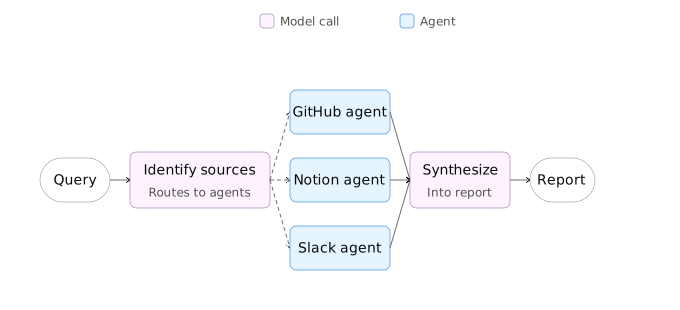
Source:https://www.langchain.com/blog/3-years-of-graph-engineering-with-langgraph
It got its name from a tweet that went out the last weekend of July by Peter Steinberger, creator of Openclaw, joining prompt engineering, context engineering, harness engineering and loop engineering as the newest term out of X's AI naming machine.
LangChain, who spent 3 years building LangGraph around exactly this idea, made a point worth noting: representing agentic systems as graphs isn't new at all. What's changed is what you can put inside a node. Early on, nodes were deterministic code or a single LLM call. Now that the agents themselves are reliable enough to trust with real work, a node can be a full agent run, you can orchestrate agents, not just LLM calls.
Let's take an example of a support workflow. One agent classifies the incoming issues, then routes it to one of two paths, answer directly or escalate, then a final agent synthesizes the response. The graph is what encodes that structure directly, instead of hoping the model figures out the right sequence on its own every time.
Get the graph right, and you can take on large, multi-part work that no single agent even if well looped could carry alone. But here's the thing, most teams rush for the trendiest layer instead of the one their actual problem lives on.
Which layer is your actual problem?
Someone reads about graph engineering and goes straight to orchestrating five agents, when the real issue is their single agent that doesn't have the right context in the first place. Someone else spends a week tuning prompts, when the actual bug is that nobody checks the output before it ships.
So before reaching for whatever's trending, it helps to ask where the problem actually is:
- Is output inconsistent or low quality for a single task? That's the prompt problem.
- Agent in hallucinating, or missing the information it should have produced? That's a context problem.
- Does the agent work sometimes and break other times, with no one catching it? That's the Harness problem.
- Does the task need more than one attempt to actually solve the problem? That's a loop.
- Multiple agents need to hand off work, share state, or specialize by role? That's a graph.
The name keeps changing. The question underneath it, what layer is actually broken, doesn't.
Conclusion
While at a glance all these buzzwords might seem overwhelming and tempting, the reason so many terms exist isn't for hype's sake, it's what the industry has started calling semantic diffusion: new terms get coined for emerging practices before their meaning has even stabilized, and the sheer number of tools and frameworks shipping right now only speeds that up. Thoughtworks latest Technology radar makes a similar point: the real inflection point in AI-built systems isn't about the technology itself, it's about technique, the practices, harnesses, and discipline teams put around the model. Every layer in this ladder is one of those techniques, not a groundbreaking shift, just a name for a real design decision builders had to make. The goal was never to chase the newest term, it's to pick the layer your actual problem lives on.
And this ladder isn't done. Software development itself is shifting from writing code to designing the systems that write, check, and coordinate code, prompts, harnesses, loops, graphs, whatever comes after graphs too. The engineers who'll matter aren't the ones who memorize this week's buzzword, they're the ones who can look at broken systems and know which layer actually needs fixing. That skill doesn't expire when the naming trend changes.